
Viewers globally had their eyes glued in anticipation to their screens last week, as “fashion’s biggest night” took the world by storm. Every year, on the first Monday in May, the Metropolitan Museum of Art holds its annual “Met Gala” to celebrate the bold and universal creativity of designers in the fashion industry.
Fittingly, this year’s dress code was “Fashion is Art”, focusing on the centrality and authenticity of humans, encouraging artists to use their bodies as canvases to honor the rich history of art. There’s no doubt that fans received a wide array of interpretations, making this year’s bar for competition quite high. Emma Chamberlain stunned with custom-made Mugler, inspired by the vibrant, expressionist styles of Vincent van Gogh and Edvard Munch, whilst Heidi Klum moulded herself into Raffaele Monti’s 1847 sculpture, "The Veiled Virgin", famous for its hyper-realistic illusion of translucent fabric carved from solid marble. Over 5000 years of history bloomed to life in the Metropolitan, reflecting the ubiquitous power of art to intertwine cultures and beliefs together in times of instability and crisis.
However, this anticipation and excitement towards the Met Gala has not always been equally appreciated, and this year was no different.
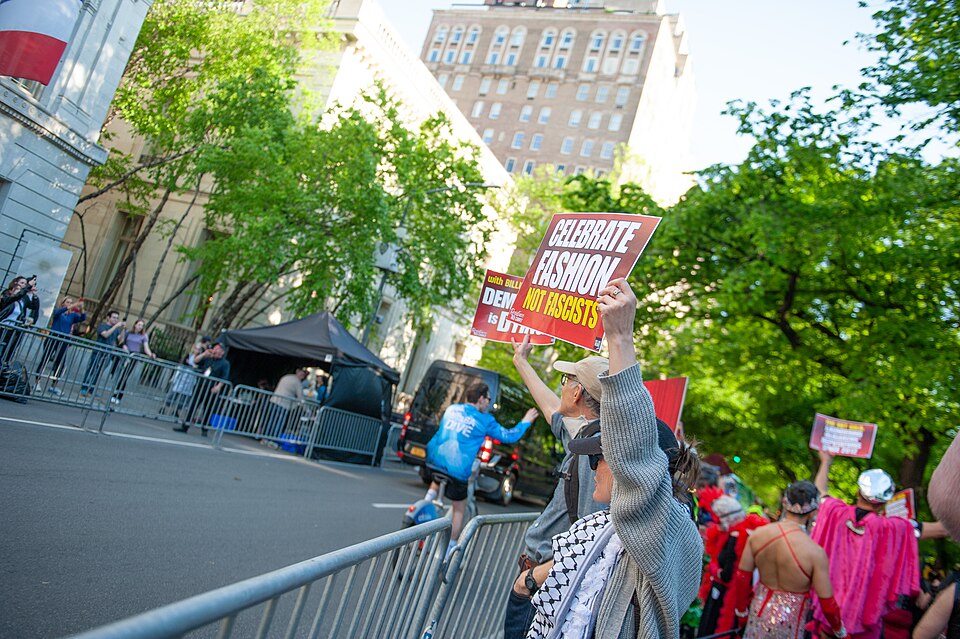
As fashion stars walked the red carpet, hundreds of laborers walked the streets in protest, plastering New York City with posters opposing Jeff Bezos’ involvement in funding the Met this year. Bezos, alongside his wife Lauren Sánchez Bezos, were invited as primary funders and honorary chairs of the Met, primarily to provide substantial financial backing to the Costume Institute at the Metropolitan Museum. Reports indicate the couple contributed more than $10 million to support the event, a move that further fuelled protests among workers at Amazon fighting against the company’s inadequate wages and unfair labor employment practices.
In particular, the British political activist group “Everyone Hates Elon” (Musk) has been a frontrunner in turning their protests into their own form of “art”; hundreds of protesters filled over 300 bottles with dyed yellow water to look like urine and lined the perimeter of the Met Museum to refer to the laborious, high-stakes work environment in Amazon that restricted them from taking bathroom breaks.
This is not the first time Amazon has received allegations of mistreating union workers; the National Labor Relations Board (NLRB) found that Amazon managers and security prohibited employees from distributing union literature, engaged in surveillance, and conducted several meetings to dissuade unionization. Moreover, the U.S Department of Labor’s Occupational Health and Safety Administration has criticised Amazon for pressuring workers under “high-stress, work intensive environments”, failing to protect them from several ergonomic injuries and being unable to provide legally required accommodations for mistreated pregnant workers.
Many critics have pointed out how the gala has devolved from “fashion’s biggest night” into a night for tech’s biggest social climbers. Big tech companies like OpenAI, Snapchat, and Meta all purchased tickets at the Met, priced at $100,000 each. “What used to be a closed-door networking event for fashion people is now a big-box clout store for the richest people on the planet,” wrote journalist Amy Odell.
Hence, many have criticised the Met for no longer championing the idea of art being universal, but rather making art exclusively for the elite, funded by the elite. Well known movie stars and media personalities have notably skipped the Gala and stood up against Bezos’ involvement, including “Hidden Figures” actress Taraji P. Henson, whose comments point out the hypocrisy of celebrities who wore “ICE OUT” pins and still attended the Gala. Musician Olivia Rodrigo also used her social media to publicly denounce Bezos by calling him a “phallic-rocket loving robber baron”, a pejorative term associated with powerful 19th-century American industrialists and financiers who amassed immense wealth through unethical, monopolistic practices.
Many workers, however, still wanted to make May 4th “fashion’s biggest night” - just not at the Met. Hundreds of labor unions and activists that day took part in the "Ball Without Billionaires" Gala in New York, a protest runway show designed as an alternative to the Met Gala, highlighting workers' rights over corporate wealth. The event featured Amazon workers, warehouse employees, and designers, championing the theme "Labor Is Art", emphasising that the dignity of workers and labor practices received just as much recognition as high-priced fashion. American actress and comedian Lisa Ann Walter joined the “Labor Is Art” protest alongside Mayor Zohran Mamdani. Walter famously criticised the Met by saying “How did an event that’s supposed to celebrate creativity, artistry & fabulousness, in all genders, end up revolving around this “Temu Lex Luthor”? Who profits off of pushing working people to their very brink.” Hence, this year’s “workers gala” has a broader motive than just criticising the elitist funding in fashion; it serves as a microcosm of the deep economic divide entrenched in urban society and calls for a heightened awareness of the injustices faced by those who keep our lives running.
So, is fashion political? There’s no doubt that all art is inherently political, as it is a medium from human ideas and beliefs to vicariously shine through. This year’s conflicts at the Met will undoubtedly change the way fashion is appreciated in the near future; one day, elegant fabrics will weave together the stories of young children exploited by labor, the voices of workers working tirelessly for inadequate pay, and above all, the heartbeat of the “common man”.
.svg)
Shreya is a student with an interest in world politics, legal ethics, technology law, and jurisprudence. She hopes to study law at university and is passionate about the critical human decisions that shape the world around us. She is especially interested in exploring how artificial intelligence will modify legal theory, judicial decision-making, and procedural fairness, a field that continues to gain prominence in modern society.
.svg)
.jpg)

.svg)
.svg)