

.svg)
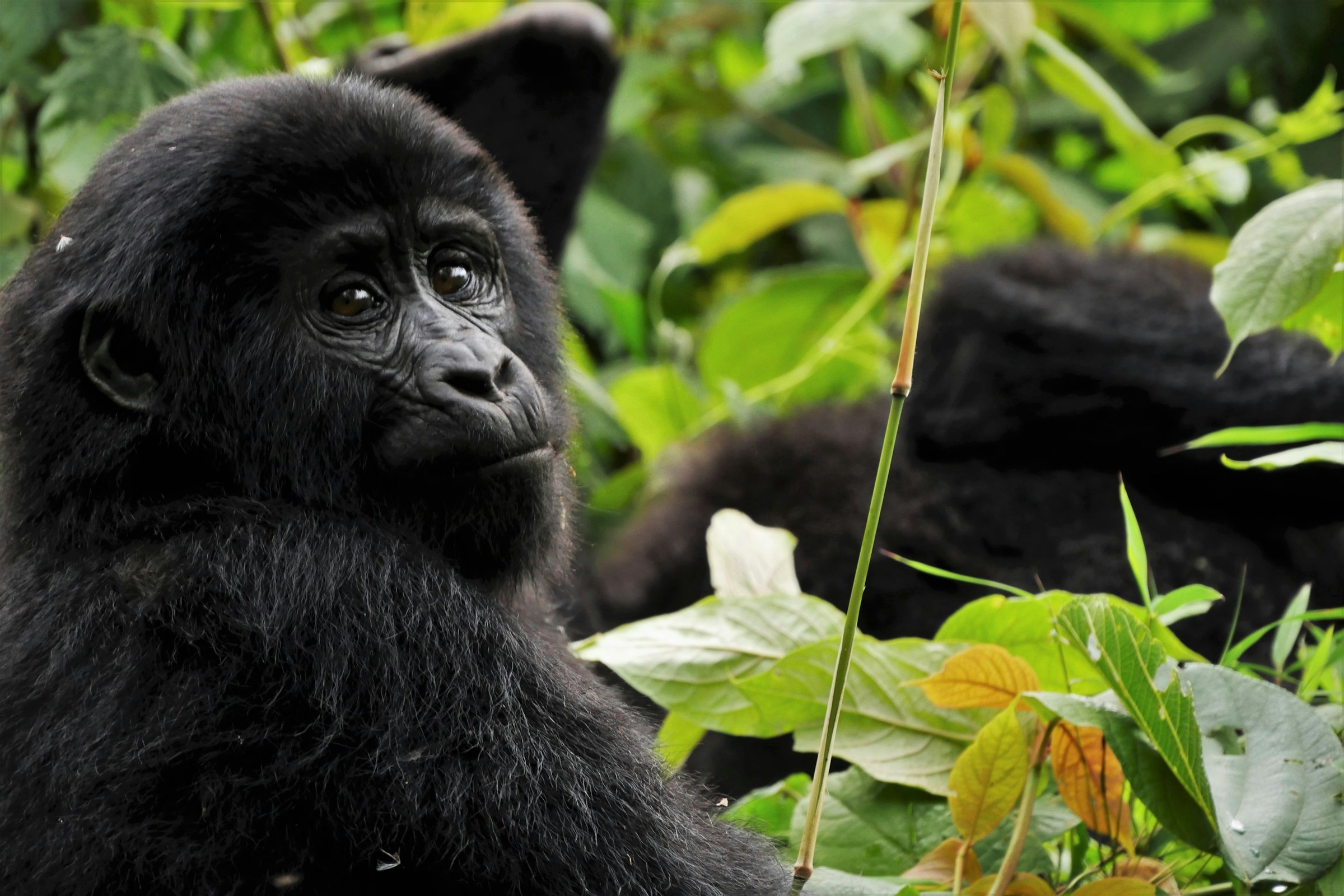
Conservation and environmental protection are often seen as a scientific issue, requiring highly technical expertise in biology and related fields. Yet in reality, the enforcement and maintenance of conservation is a deeply politicised topic, involving a wide range of actors and institutions whose interests frequently clash. This article explores the political nature of conservation through the case of Uganda’s Bugoma Forest. In an interview with Tony Ofungi, a prominent activist and sustainable tourism operator in the region, these dynamics came to the forefront. As a member of the ‘Climate Friendly Travel’ network, he highlights how nature-positive solutions dependnot only on environmental knowledge, but on the effective use of institutions and community-led initiatives.
Located in Western Uganda, the Bugoma Forest is home to someof the richest biodiversity in the region. As one of the last remainingwildlife corridors in East Africa, it sustains key endangered species,including the Uganda mangabey primate and significant populations ofchimpanzees. In 1932, over 40,000 hectares of forest were gazetted under theBritish colonial administration. Whilst this seemed like a way to protect apristine landscape from human activity, it also reinforced colonial practicesof displacement in the name of conservation. Furthermore, it also suggestedthat conservation in colonial Africa was motivated as much by political motivesas by environmental concerns.
During this time, the territory was reorganised into different land tenure systems, with some pre-colonial kingdoms retaining their cultural influence, albeit without any political clout. Following independence in 1962, however, all the land in the country became centralised under the state, and the semi-autonomous status of these kingdoms was abolished. Amongst them was the Bunyoro-Kitara kingdom, whose historical territory covered the entirety of the Bugoma Forest and extended into the neighbouring Democratic Republic of the Congo.
In 1993, the Traditional Rulers Act was passed to return some land and assets to traditional kingdoms across Uganda, including the Bunyoro-Kitara. Whilst this returned some degree of autonomy to local entities,it also exposed them to new political and economic pressures, particularly to extractive industries. Amongst the most influential were sugar corporations, which secured leases for approximately 22 square miles of forest for plantation developments. Although this decision was highly contested within the Bunyoran cabinet, the personal greed of a small minority ultimately enabled the expansion of multinationals.
There has also been evidence of companies bribing locals and keeping them as hostages to abandon their traditional crops, thereby increasing pressure on the kingdom. At the same time, other lucrative businesses such as timber and charcoal burning were also adding fuel to the alarming rates of deforestation in the last decade. Together, these pressures reveal the wide range of actors involved in Bugoma’s degradation and emphasise the complexity of resolving it.
At present, the Bugoma forest is managed by the National Forest Authority (NFA), an organisation that Tony and 12 other activists took to court in 2020 for failing to carry out an Environment and Social Impact Assessment (ESIA). Other concerns included the NFA’s limited capabilities to prevent activity from loggers and mafias, as well as its lack of a specialised enforcement force on the ground. In this context, the constant “chainsaws heard at night” are not only the product of illicit activity, but also of systemic governance failures. Only recently has the Ugandan government issued a directive involving the Ugandan Wildlife Authority, which, according to Tony, may offer a more effective mechanism for strengthening enforcement.
Nevertheless, bottom-up, grassroots movements are equally(if not more) important than top-down governance institutions. As Tony notes,“without the grassroots, you are only speaking in silos”, preventing a crucial source of the possible change. In many cases, institutions aiming to deliver genuine positive outcomes can unintentionally perpetuate inequalities on the ground. Just as in 1932, when the British administration gazetted the land to “protect” the forest, the exclusion of local communities led to widespread displacement, reinforcing inequalities and the flawed idea that conservation requires a stark division between humans and nature.
Instead, it is fundamental to recognise that the knowledge of local populations is and has always been the most valuable for managing their environments. In the case of Bugoma, these communities have lived in close relationship with the forest for centuries, sustaining their livelihoods without compromising the ecosystem. Indeed, the name “Bugoma” itself comes from a word meaning “drum”, as these were produced using forest resources in a sustainable manner.
Building on this emphasis on local knowledge, Tony has long been engaged in ecotourism. He describes this sector as one of the most effective ways to preserve not only the biodiversity of the Bugoma Forest, but also the knowledge systems and practices of local communities. For him, being an “ecotourist” means being prepared to “observe the best practices” and to develop a meaningful understanding of host communities, whom he actively involves as guides and “guardians” of the forest.
Furthermore, the Ugandan Wildlife Authority emphasises the need for at least 20% of profits to stay within the community and to be reinvested in infrastructure and improvements to quality of life. In this way, ecotourism offers an alternative to extractive industries by enabling communities to maintain their traditional livelihoods and share their knowledge of the forest, rather than being pushed into dependence on a single crop.
This article has demonstrated that the question regarding conservation is, as Tony puts it, “as complex as a katogo plate” – a traditional Ugandan dish in which multiple ingredients are mixed altogether. Effectively protecting an area like the Bugoma Forest begins by identifying how its history and present-day pressures continue to make it vulnerable. From there, it requires determining who gets to control the land, who oversees decision-making, and whose livelihoods are prioritised.
A special thank you to Tony Ofungi for sharing suchthoughtful insights and fascinating experiences.
.svg)



.svg)
.svg)

