

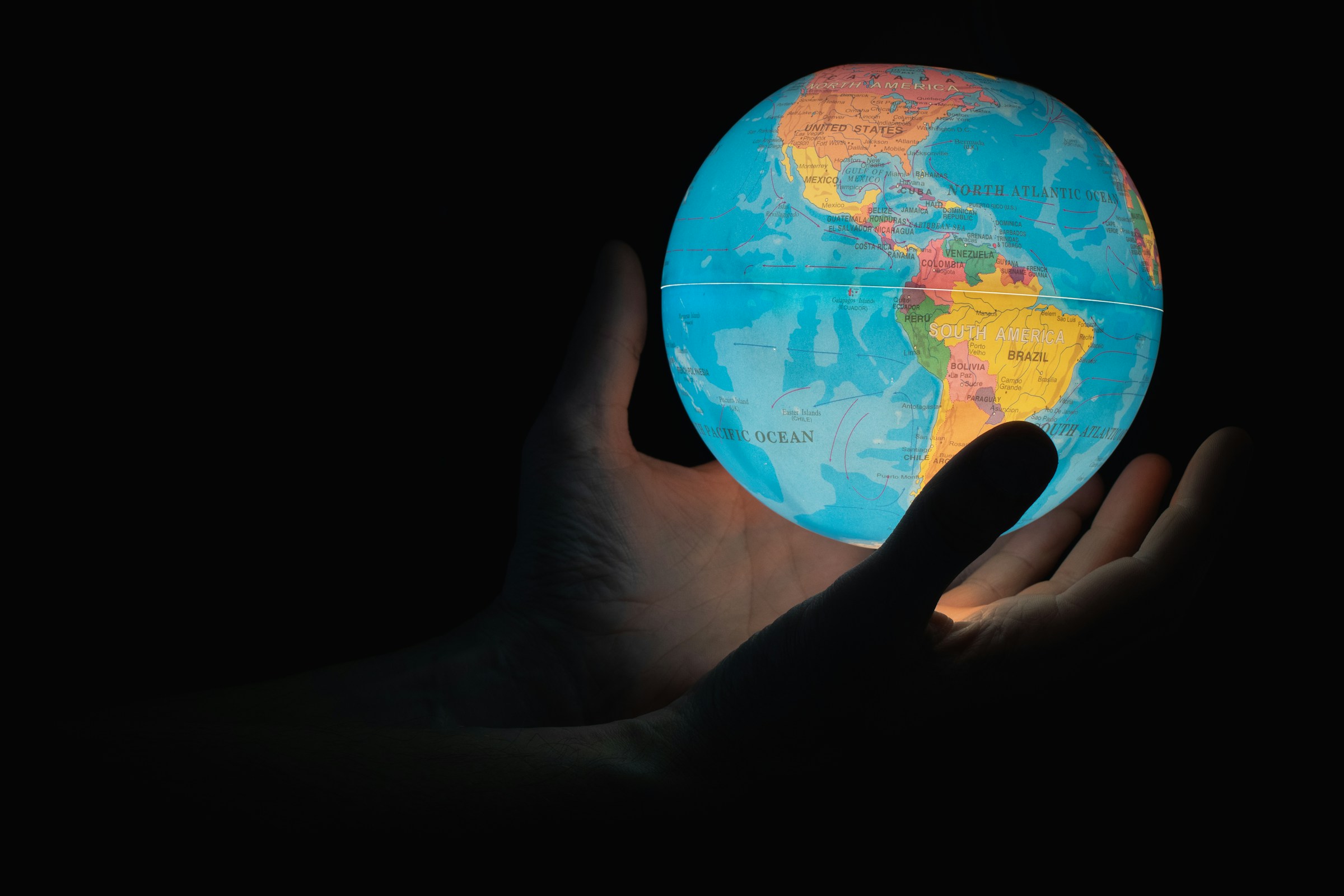
Image - Greg Rosenke
In recent decades, and particularly in Trump’s current presidency, the US has maintained and intensified US influence in South America. The US has historically had varying levels of intervention in South America, most notably after the 1823 Monroe Doctrine (which asserted US dominance over the Western Hemisphere, particularly South and Central America and the Caribbean) and during the Cold War. This included military support and coups (especially during the Cold War), intelligence operations, diplomatic pressure, and economic leverage (such as tied IMF loans, trade agreements, and sanctions). The Trump administration has revamped US efforts to control various South American countries, characterised by putting in pro-American leaders who will allow US companies access to natural resources and support US foreign policy aims.
To understand Trump’s focus on expanding US imperialism, the National Security Strategy of the United States, released in November 2025, is integral. Trump’s opening letter is filled with narcissism, American centrism, and distain for internationalism, including international law, multilateral institutions, and the UN. Trump asserts US foreign policy aims as restoring ‘American strength at home and abroad’ and making America ‘safer, richer, freer, greater, and more powerful than ever before’. Trump’s priorities are summed up in his assertion that ‘In everything we do, we are putting America first.’ There is a clear emphasis on US power and international dominance. The document focuses particularly on South America and the revival of the Monroe Doctrine, now called the ‘Trump Corollary,’ or colloquially the ’Donroe Doctrine’, which has reemphasized US aims to assert control in South America. The Security Strategy rejects the post-Cold War aims pursued by Obama and Biden, characterised by failed state-building expeditions in Libya, Iraq and Afghanistan. Instead, it focuses on resource extraction, largely oil and rare earth minerals, to fuel large US corporations, while abandoning multilateralism, seen by US withdrawal from 66 institutions.
The US currently has influence in many South American countries, with leaders like Argentina’s Javier Milei and Ecuador’s Daniel Noboa having strong alliances with the US, including their government’s taking inspiration from the Trump administration and receiving financial and diplomatic support from the US. Much of the current American intervention in South America is not a recent phenomenon but has roots in the Monroe Doctrine and Cold-War eras of US foreign policy. America has intervened in Argentina for decades, most notably with the US backing of the military junta, who formed a civic-military dictatorship in Argentina from 1976 to 1983. The US provided military assistance to the junta, and the Secretary of State Henry Kissinger gave the dictatorship the go ahead to enact political repression of opponents, which is now known as the Dirty War and involved the systematic kidnapping, torture, and forced disappearance of thousands. Domestic issues, including severe economic issues and defeat in the Falkland's War by Britain, led to the restoration of a constitutional democracy. However, the dictatorship and US backing of the suppression of opposition has left a legacy of deep political polarization in Argentina, leading to political swings from right to left over the last few decades.
This has created a political climate in which the right-wing Javier Milei was voted in, in 2023. Milei expressed his support and admiration for Trump right from the start of his presidency when he openly supported Trump’s campaign for presidency, leading to close ties between the two presidents following Trump’s re-election in 2024. US financial investment in Argentina, including a $20 billion stabilization package, has helped with the country’s stability and inflation. However, this financial support comes with strings attached; the US has been strengthening its commercial ties with Argentina, focusing on the development of critical mineral supply chains, mainly lithium, which Argentina is the third largest producer of and is essential for the US’ commitment to developing smart technologies. Most of Argentina’s lithium lies in the salt flats of the Puna, which are in the Andes mountain range. Milei favours economic development and supplying Trump’s desire for lithium over protecting the Argentinian environment. Hence, his plans to implement reforms to shift control of defining protected areas to provincial governments, with the aim of enabling investment in mining, especially copper and lithium, which will weaken protection of glaciers, particularly smaller ones. As well as pressure to increase lithium exports, financial support for America encourages Argentina to follow US foreign policy. Milei has joined Trump is leaving various international organisations, ignored the invasion of Ukraine, supported Trump’s attack on Venezuela, and joined Trump’s Board of Peace. Trump made it clear that US financial support was conditional and relied on Argentina having a pro-America leader when, in the run up to the elections in Argentina in October 2025, he revealed that if Javier Milei did not get in, the US would stop financial aid to Argentina. Thus, US intervention in Argentina demonstrates Trump’s foreign policy aims of extracting natural resources and securing foreign leadersthat are subservient to US geopolitical aims.
With its vast oil reserves, Venezuela has also become a vital part of US foreign policy. Venezuela has a long history of US involvement, including financial sanctions, support for opposition movements, and diplomatic pressure on multiple governments. However, towards the end of 2024, Trump intensified US intervention in Venezuela, including weeks of explicit threats, attacks on vessels allegedly transporting drugs, and seizures of tankers carrying Venezuelan oil. This culminated in the kidnapping of Venezuelan President Nicolás Maduro and his wife on the 3rd of January 2026, allegedly on grounds of drug trafficking charges. This act of imperialism, continuing the US trend of actively disregarding the autonomy of foreign leaders, was emphasised by Trump’s declaration that ‘We are in change’ of Venezuelan governance until the country was ‘stabilised’ sufficiently to restore oil production under the guidance of US corporations. After Maduro’s kidnapping, many assumed that Maria Corina Machado would be installed as president due to her support for US intervention and her being the right-wing opposition leader. However, Trump dismissed her, saying that she did not have enough ‘respect’ in the country as he believed that she lacked sufficient domestic support to stabilise the country. Instead, Trump installed Maduro’s vice- president, Delcy Rodiguez, as interim president due to his confidence that she would cooperate with US interests, particularly in relation to Venezuelan oil, and she had broader popular support, making her more able to restore stability. Trump asserted that the US was ultimately in charge of Venezuela by warning that she would pay ‘a very high price’ if she did not make Venezuela's vast oil reserves available to American companies.
The seizure of Maduro and Trump’s love for Milei are not an isolated incidents but are telling of Trump’s wider geopolitical aims. While previous US intervention in South America was framed around defending democracy against capitalism, this was not the case with the Venezuelan attack or financial support for Argentina. Trump has been open that the attack in Venezuela was not about crushing socialism, but about gaining control of the country’s oil. The attack on Venezuela involved seizing oil tankers bound for China and Russia and was followed by control of oil reserves being transferred to US companies, demonstrating Trump’s geopolitical aims to have control of the majority of global oil reserves. As well, Trump’s financial and diplomatic support of Milei relies on Argentina’s unconditional support for Trump and provision of natural materials to American companies. The US’ quest for control of global supplies of resources like oil and lithium and its desire for subservient states, not allies, is reminiscent of nineteenth century British imperialism.
While Britain did not celebrate Maduro’s capture, Kier Starmer did give the US all the help it requested in the seizure of the Russian-bound oil tanker. The UK and other European countries have turned blind eyes to Trump’s imperialistic geopolitical aims, allowing Trump to do as he pleases in South America. Trump has not given any indication that he intends to stop either; he openly linked the attack on Venezuela to future regime-change efforts in Colombia and Cuba, including directly threatening Cuba, writing on his Truth Social platform in December 2025: ‘I strongly suggest they make a deal, BEFORE IT IS TOO LATE.’ Bringing down the Cuban government has been a US aim for decades since the 1959 revolution in which Fidel Castro came to power, including the US attempt to overthrow Castro during the Bay of Pigs Invasion in 1962. The desire to overthrow the communist Cuban leadership has prevailed and is seemingly one of Trump’s current geopolitical plans. Trump is actively trying to find politicians in Havana who are willing to make a deal with Washington; Trump will support them in power if they are willing to bend to the whims of US foreign policy aims and supply the US with natural resources. Clearly Trump’s desire for control over South American politics and resources is insatiable, and it must be halted. Europe should not be aiding this kind of aggressive and destructive geopolitics and if this sort of neo-colonial US foreign policy is to be stopped, the UK and Europe need to be much harder on Trump and present a united opposition to US expansionism.
.svg)
Verity is a final year history student at the University of Manchester. She is most interested in geopolitics, particularly European politics, including a particular interest in the rise of the far-right in Europe, US neocolonialism, and the politics of democracy and extremism. Outside of studying and writing, she loves running.
.svg)


.svg)
.svg)

