
Image - Rosemary Ketchum
For many of us, January marked a fresh start. A chance to start a new leaf, to turn the other cheek. In typical fashion, we set resolutions. Some were ambitious, some were arbitrary, all were well-meaning. Despite our noble intentions, many of us likely failed to stick to our goals for the same old reasons. Honestly, it’s ok, don't beat yourself up. We all did it! I mean, just look at the most powerful man in the world’s most powerful country, US President Donald Trump…
You might have wanted “Peace. Peace on Earth.” But what about the oil- I mean, rare earth minerals- I mean, global security…fentanyl? Yes, it seems even Presidents struggle to stick to their resolutions, with Trump lasting as little as three days before kidnapping the President of Venezuela, as little as nine days before threatening regime change in Iran, and as little as twenty-one days before attempting to impose tariffs to conquer Greenland. It’s still only January, and it has somehow already been a busy year. While seemingly unrelated, these policy decisions mark a radical shift in the Trump administration's approach to foreign policy, moving decidedly away from Art of the Deal rhetoric and toward action in defiance of international law.
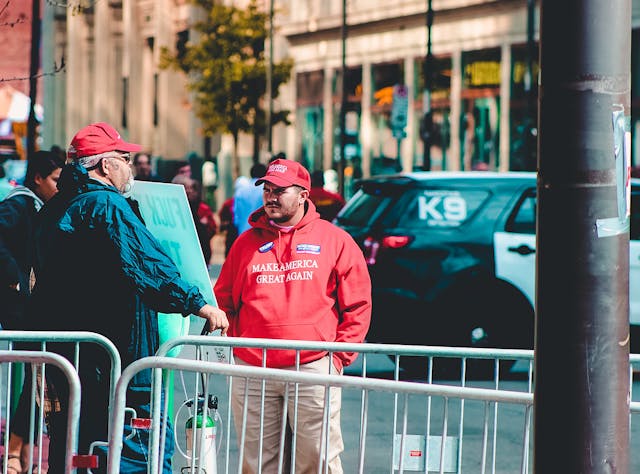
Almost a decade ago in 2016, then President-elect Donald Trump promised a crowd in Fayetteville, North Carolina, that, under his leadership, the US would stop “racing to topple foreign regimes that [it knew] nothing about”, and start focusing on issues at home. Now, though, Trump seems to have forgotten that promise. While his provocations against Venezuela and Greenland are contained to the hemisphere which his administration presumably does claim to ‘know something about’, the same cannot be said for his latest threats to the Iranian regime, nor for his proposed Gaza reconstruction plan. Trump’s changing foreign policy agenda is a symptom of a greater issue facing the MAGA movement: its lack of intellectual centre.
On voter demographics alone, the multi-ethnic coalition that contributed to each of the administration’s electoral victories is becoming alienated, as MAGA succumbs to its increasingly indistinguishable alternative, America First. Rather than continuing to reject identity politics, for example, growing numbers of America First-curious MAGA supporters are instead fixating on it, even if they don’t recognise it as such. By classifying citizens with links to European Protestant settlers as Heritage Americans, these supporters are effectively emphasising identity according to ethnic purity. The ‘greatness’ to which they wish to return seemingly has more in common with Social Darwinism and Manifest Destiny than it does with the isolationist capitalism of 2016 MAGA.
Combined with this value reversal is the increased platforming of formerly fringe alt-right figures. Over the past year, mainstream MAGA influencers, such as Tucker Carlson, have increasingly platformed notorious alt-right influencer Nick Fuentes. Recognised in Conservative circles for his intensely anti-Semitic, occasionally anti-administration, and extremely pro-Christian views, Fuentes’ growing popularity, in particular, signals the extent of the broadening rift in the American Right. His impact was especially felt in the aftermath of the most recent AmericaFest conference held in December. An annual gathering of conservative voices under the banner of Turning Point USA, last year's event was the first held following the assassination of Turning Point’s founder, Charlie Kirk. Kirk’s loss has noticeably deprived the right of a figure capable of uniting its 2016 MAGA and alt-right wings. This has led to each side embattling the other in an attempt to win the soul of the Republican Party in time for the 2028 Presidential Primaries.
For his effort, former Republican presidential candidate and current gubernatorial hopeful Vivek Ramaswamy used his AmFest speech to call for unity among conservatives. Addressing the floor, Ramaswamy denounced Heritage American status as “about as loony as anything the woke left has actually put up”. He further determined that “there is no American who is more American than somebody else”, provided they recognise the value of “merit” over the arbitrary nature of “skin colour”. And those on the right who do value the arbitrary nature of skin colour, such as hardliner America First supporters? Ramaswamy concluded that these voters who “believe in normalising hatred toward any ethnic group” would “have no place in the future of the conservative movement”.
While the speech would have almost unanimously been recognised as reflecting mainstream modern American values as little as ten years ago, in the age of post-MAGA and ascending America First, this is no longer the case. Fuentes and the online right rebuffed Ramaswamy, stating that he is misguided if he believes “telling white people that [he is] as American as them” will win him the election. After directing a range of slurs to both Ramaswamy and his family, including his children, Fuentes concluded that he should “go back to India”, adding that America is “not [his] home”. While the regular extremity of Fuentes’ content combined with his autonomy over his platform renders him theoretically uncancellable, his open disregard and contempt for establishment Republicans exemplifies the depth of the division among the American right. Equally, the extent to which Fuentes and his fellow far-right contemporaries are platformed by mainstream sources is illustrative of MAGA’s unbridled success in toxifying America’s political discourse.
America First’s growing popularity demonstrates the extent to which MAGA has profoundly altered both the nature of political communications and the Overton Window in the United States. The willingness of so many 2016 MAGA voters to compromise entirely on the movement’s founding values of non- interventionism and rejection of identity politics is reflective of their leader’s total lack of intellectual consistency. By lacking any concrete vision for America beyond that which has provided him with either self-enrichment or empowerment, Trump has created an untenably broad church of supporters. The consequences? A group whose leading online voices launch bigoted and racist attacks against their own establishment figures, all the while threatening to shatter America’s national identity in the process. At least we can hope it will be someone other than Trump in charge of reassembling the pieces.
.svg)
Mark graduated from Newcastle University at the end of 2025 with a Master's in Urban Planning. He's interested in rising inequality and the politics of populism. Alongside politics, he enjoys hiking and travelling.
.svg)


.jpg)
.svg)
.svg)