

.jpg)
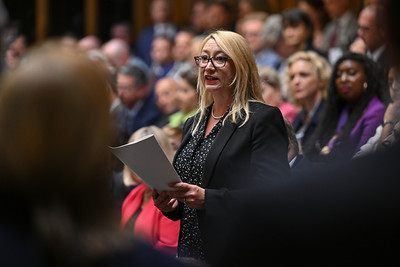
Last week, Hannah Spencer did something historic. The 34-year-old plumber and Trafford councillor won the by-election in Gorton and Denton for the Green Party. This is the first time the seat has not been occupied by Labour since 1931. It was not a ‘knife-edge’ win either; Spencer took almost 41% of the vote, beating both Reform and Labour, the former by 4,402 votes. An unexpected and interesting democratic feat in British Politics, particularly because Starmer’s Labour did not see Green as an opponent, previously focusing their efforts on rebutting Reform and the Conservatives, and Gorton was 127th on Green’s target-seat list. But they won, and Spencer became the 5th MP to join the Green Party in parliament.
But by lunchtime on the 27th of February, the win had been reframed.
Nigel Farage explained why it didn’t count. ‘A victory for sectarian voting and cheating,’ he posted on X. Matt Goodwin, the Reform candidate who finished in second, had been seeding his own doubts through a series of tweets before the count was even over.
Keir Starmer declared that ‘divisive sectarian politics is a sign that the Greens are not the harmless environmentalists they pretend to be.’ Anna Turley, a Labour MP, described the victory as ‘the politics of anger.’ Kemi Badenoch put out a party statement that began ‘Labour created the monster of harvesting Muslim community bloc votes, and yesterday that monster came back to bite them.’ All while GB News ran back-to-back coverage of campaign letters sent out in Urdu, because apparently it is a scandal that the Greens had communicated in a language spoken by a significant portion of the constituency they were trying to win. Farage could have done the same if he wanted, but considering he is [actively campaigning to remove English language support services](https://feweek.co.uk/fundamentally-wrong-greater-lincolnshire-leaders-approve-esol-cuts/#:~:text=Plans to cut funding for,skills fund budget in September.), I understand how this anti-monolingualism approach could confuse his supporters.
However, this isn’t an article on Gorton and Denton. Of those, there are plenty; the by-election is being described as ‘seismic’ since it may pose a real threat to our ‘two-party’ system. What I want to examine is the gap between what happens in elections - a decisive democratic result - and the narrative infrastructure immediately deployed by the defeated parties and their media allies to make it feel like something else. This matters more than we realise because it goes beyond being a sore loser or passing incidental commentary. It is a strategic and effective form of political communication.
There is substantial research on media interference during an electoral campaign - I, myself, wrote an entire dissertation on it. But there’s far less out there on what happens after. On how the words chosen in the hours following a result shape how that result is remembered, interpreted, and acted upon. This is the gap last week's events made visible.
We tend to dismiss political language. Like it’s just the plastic packaging around the real substance of policy, power and votes. This is a mistake. Language is so important in politics because much of politics is about perception, so the words politicians use are not just how they describe political reality, but also how they construct it.
If they called this loss a ‘democratic upset', the public asks, what went wrong for Labour? Call it ‘sectarian cheating’, and the question flips focus to Green’s legitimate win and becomes, how do we stop this from happening again? The same election result, yet completely different political conversations are emerging from it.
‘Sectarian’ is not a neutral word in politics. It has a long history. In British politics, this history mostly relates to Northern Ireland, where a century of religious division and tribal violence separated a nation. The word ‘sectarian’ has constantly been used by authoritative figures to exclude and marginalise groups whose religious and philosophical beliefs do not correspond with their own. Using ‘sectarian’ in arguments implies that a contrasting mainstream way of thinking exists, one that is right. Importing it into the Greater Manchester by-election results is a specific choice. It presents a situation where there’s an ‘us’ vs ‘them’. And by the Greens winning, the ‘them’ have won. It frames Muslim voters exercising a democratic choice as a threat, opposed to a citizen's right and encourages voter polarisation.
Richard A. Baer, Jr puts it well in his article, ‘The Supreme Court’s Discriminatory Use of the Term “Sectarian”’:
‘The term “sectarian” carries with it such a generous supply of negative connotations that its use as a synonym for "religious" is inevitably prejudicial, no matter what the writer’s intent.’
Labour MP Naz Shah posed the obvious question; “If voters angry about Gaza are sectarian, what do we call politicians who appeal to other sections of society on immigration?”
She continued, “The logic does not even hold. How do supposedly ‘sectarian Muslims’ end up voting for a radically progressive party with a gay Jewish leader?”
Greater Manchester Police confirmed they were ‘reviewing’ the reports of family voting. But ‘no such issues have been reported’ by polling station staff. As of publication, no evidence of systemic fraud has emerged. A Greens party spokesman described the response to the win as “an attempt to undermine the democratic result and is straight out of the Trump playbook.”
But for Farage and Goodwin and their friends at GB News, it was never about concrete evidence. It was to get the allegation out fast enough that it taints the result with a question mark. It becomes how Spencer's win is remembered, regardless of whether it was ever substantiated.
Ask most people what they remember about the 2016 US election, the language used in the media stays with us more than the events - ‘fake news’, ‘stolen’, ‘rigged’. This inflammatory language becomes stored with how we recall things and the world witnessed on January 6th, 2021, what election degradation at its most extreme can lead to.
Reform gets the most coverage for this type of response, partly because Farage does it the loudest. But figures on the left mirror his actions. The impulse to contest the meaning of a result before absorbing it is structurally identical, no matter which side of the spectrum you sit.
In 2019, after Boris Johnson won an 80-seat majority, the dominant response was media bias and voter suppression. Part of it was true, the lies about hospital beds and where taxpayer money was spent. And after Brexit, the most common response was not to accept that people voted, and this is what the British public chose: ‘they didn’t know what they were voting for’. This is an example of delegitimisation, where the result is skewed because the public was deceived.
When a political party loses, media coverage tends to reach for character-based critique rather than policy-based analysis. A defeat is attributed to a leader being ‘weak’ or ‘out of touch’ rather than the political choices they made that alienated voters. We saw the media vilify Jeremy Corbyn, and they are beginning to do the same with members of the ‘margin’ parties, Green and Reform.
This being a by-election means campaigns can capitalise on it to achieve the results they’re after in local and general elections.
There tends to be a recognisable pattern in the anatomy of post-election coverage.
First: delegitimise the win. Question whether it was really a win at all. ‘Sectarian voting’, ‘a dirty campaign’, ‘interference’, ‘fraud’. Get the doubt out early.
Second: attack the process. ‘The campaign was run unfairly’. ‘Our country’s system is broken.’ They used foreign languages!’. ‘They exploited a foreign conflict…’.
Third: minimise the result. ‘By-elections are different.’ ‘Protest votes don't translate.’ ‘We weren't very prepared.’ ‘The turnout was weird.’
Fourth: reframe as your own victory. 'We doubled our vote!’ 'Roll on May 7th.' 'The leadership is not in question.' Use the loss as a springboard!
Fifth (optional): propose structural reform. Specifically, the reform that would have helped you win. Farage called for restrictions on postal voting within hours of a result in which postal votes appeared to have gone against him. He also called for a reform on allowing Commonwealth citizens who qualify as UK residents to vote, claiming that the Reform would have won if only British citizens voted. He said that ‘normal’ countries already do this.
“I’m absolutely convinced that amongst British-born voters, Matthew Goodwin came first in that election last week,” Nigel Farage said at a press conference on Monday. This is further cementing the ‘us’ versus ‘them’ rhetoric and the anti-democratic stance that if you don't like the results of an election, change the electorate.
This Green victory was a convergence of several factors. Under Zack Polanski, the Green Party has surged. In only six months as party leader, he has seen memberships rise by 186%. He has a large social media presence, he is charismatic, and an eco-socialist. He is the only party leader who is overtly anti-genocide, and this appeals to minority groups in the country. Then combine this with Starmer blocking the popular candidate, Andy Burnham, Greater Manchester’s Mayor, from running. A decision later described by the Mainstream Labour group as a ‘catastrophic mistake’.
The opposition contesting the win is nothing new; it’s predictable horse-race politics. But elections work when losers accept that they lost, so they can calibrate and come back improved. Every time a party calls a result ‘sectarian’ or ‘the politics of anger’, they are not accepting that, so nothing is changing. Hannah Spencer won, and the question worth asking is not whether the result was legitimate but why so many people with platforms have spent the past week trying to convince you otherwise.
.svg)
.svg)


.jpg)
.svg)
.svg)


.jpg)