

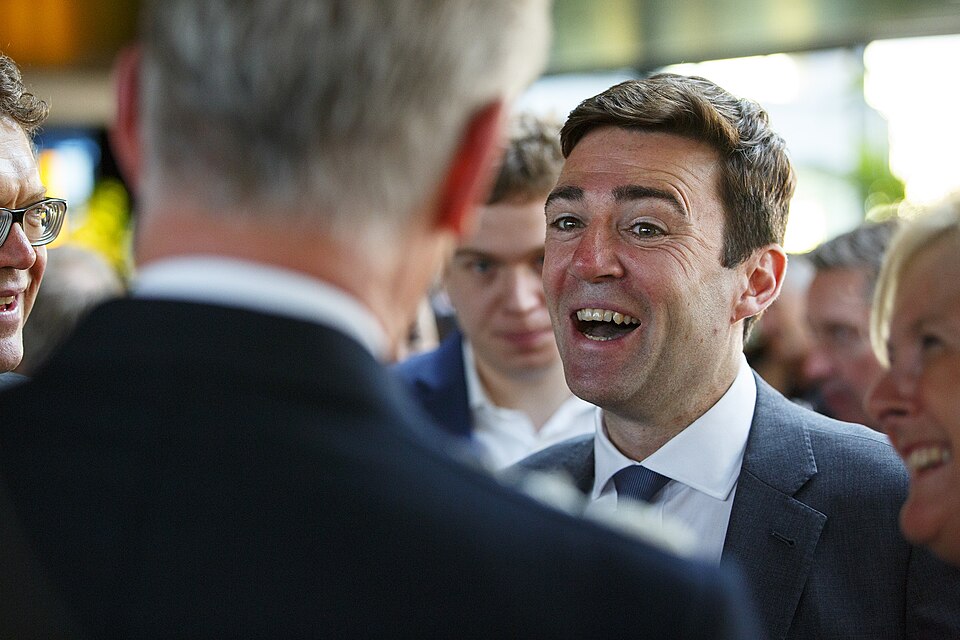
On the 18th of June, despite predictions of a close contest, Andy Burnham won the Makerfield by election with a landslide 54.8% of the vote while Reform UK came second, achieving 34.5% in a territory they believed was theirs for the taking. It was a contest of three significant features: former Greater Manchester Mayor Andy Burnham took a big and successful gamble, the high polling Reform UK now suffer a threat to their electoral prospects, and Prime Minister Keir Starmer’s subsequently resigned.
The By-Election
Following major losses for Labour in local elections to both the left and the right, and mounting pressure on Starmer to resign, the resignation of MP Josh Simons in Makerfield paved the way for Andy Burnham’s return to Parliament. Unlike in the Gorton and Denton by-election earlier this year, Burnham was not blocked from standing, a sign of Starmer’s weakened position as leader and the consolidation of Burnham as a challenger for Labour leadership.
The defeat was a sobering one for Reform UK, who had achieved significant gains in the earlier council elections in Makerfield yet underperformed against polling for a second time this year in the by-election. Their candidate, Robert Kenyon, appeared to have been chosen to appeal to the party’s base. A local plumber, recently elected councilor, and former Army reservist, he embodied the anti-establishment ethos that the party brands itself as.
Kenyon’s campaign attempted to appeal to the electorate by contrasting Kenyon’s local roots and outsider image against Burnham’s national ambitions. However, these efforts were damaged when his old social media posts resurfaced and cut through to voters, among them a variety of misogynistic remarks and conspiracy theories. Survation’s polling in the run-up to the by-election found Burnham leading by 21 points among women, against Reform’s 15 point lead among male voters.
The same constituency poll also underlined the significance of candidate-centred voting, or what can colloquially referred to as the Burnham effect. Survation recorded that without a candidate name attached, Reform UK beat out Labour in Makerfield polls by eleven points, while in a named candidate by-election Labour narrowly clawed ahead with a three-point lead. As we now know, the Greater Manchester Mayor’s pull was even greater, delivering victory over Reform by more than 20 points.
This poll, and the subsequent election results, equally suggest dissatisfaction toward the Labour Party itself and that Burnham’s victory was, in part, a protest against Starmer. At the same time, the results reflect the wider issue Reform is facing; the allure of the image the party projects struggles to maintain credibility when the spotlight is pointed directly at their candidates.
While momentum behind Restore Britain, led by former Reform UK MP Rupert Lowe, ate up 6.8% of the vote from Reform, even a united right still wouldn’t have been enough to beat Burnham. Meanwhile, the Greens and Lib Dems significantly underperformed against polling, highlighting both the by-election’s subversion of national trends as well as the landslide Burnham achieved. This is indicative of the strength of tactical voting when collectively deployed against Reform.
While polling depicted the election as being balanced on a knife-edge, hinging on whether the right could consolidate behind a single party, the results revealed that even in the case of such solidarity, Labour’s victory was secure and tactical voting actually took place behind Burnham.
What Next?
The landslide victory in the by-election has had significant wider implications. Starmer has announced his resignation and Burnham is poised to take up the mantel as Prime Minister, having showcased his electoral appeal and achieved large amounts of support from the parliamentary Labour party.
The Makerfield campaign, however, has already shown symptoms of the very tensions Starmer struggled with in balancing competing electoral interests. Facing a Eurosceptic constituency and Kenyon’s campaign focus on immigration, Burnham U-turned over his support for rejoining the EU and his opposition of Shabana Mahmood’s extension of migrant appeals for indefinite leave to remain.
Despite the tensions, Burnham’s victory speech carried all the trappings of a revitalised presentation of the Labour Party, as the discursively downbeat pragmatism of his predecessor gave way to a more emotional register and a call for a politics of hope. In a political landscape where emotional appeals to the electorate have been claimed by the left-wing progressivism of the Green’s Zack Polanski and the right-wing populism of Reform UK’s Nigel Farage, Starmer’s rhetoric of political sensibilities took a backseat. Burnham’s speech as prospective Prime Minister is indicative of a shift in Labour’s electoral strategy. It was the promise of change, paired with a understated self-image of Starmer as leader, that won Labour a landslide in 2024 yet this strategy also sealed his eventual resignation. Starmer’s technocratic centrism was targeted by his political opponents, who conflated the politics of change with the politics of immediacy, and thus saw his premiership as a letdown.
Burnham’s politics of hope will face a significant challenge in uniting the Labour party, as hope itself is a significantly contested concept across the Labour Party’s factions. This is a tension that has plagued the party from its very conception and has accelerated significantly in the 2000s, from Blair’s election, to Corbyn’s unravelling, and Starmer’s entire tenure. How Burnham will manage the balancing act he faces from all angles of the electorate, and from his own party, remains to be seen. As he has claimed, the country has been ‘on the wrong path for 40 years’, the challenge he now faces is to sustain the narrative of hope and optimism with a clear new agenda that remains a tangible objective.
In our current landscape, where a Sky News helicopter tracks the King of the North’s train journey to Westminster, casting him as a beacon of hope, the larger question that remains is whether the Burnham effect is truly sustainable and whether it can keep up with an increasingly fragmented electorate.
.svg)
Harry Gillingham, Second Year Politics and International Relations student at the University of Bristol. Interested in analysis of international affairs and the application of political theory in contemporary politics.
.svg)


.jpg)
.svg)
.svg)


.jpg)