

.svg)
.jpg)
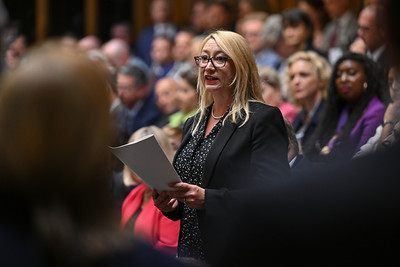
Image - Alice Hodgson/10 Downing Street
Keir Starmer is reportedly preparing to offer London Mayor Sadiq Khan a life peerage, a seat in the House of Lords, amidst May's local elections which are widely forecast to produce damaging results for Labour. Starmer, who pledged to abolish the House of Lords as part of his leadership campaign, is now seeking to fill it with allies and critics to prevent his potential backlash he faces.
In recent months, Sadiq Khan has positioned himself as a vocal critic of Keir Starmer from within the Labour left, challenging the Prime Minister's stance on several key policy areas. Following Labour's humiliating third-place finish in the Gorton and Denton by-election, Khan publicly criticised Starmer's approach to Brexit, immigration, and Gaza, and has separately advocated for the decriminalisation of cannabis, a position at odds with the government's current direction. Against this backdrop of internal friction, multiple reports have emerged suggesting that Starmer is considering offering Khan a life peerage following the May local elections, a move characterised by some commentators as an attempt to consolidate his position through political patronage at a moment of considerable vulnerability. Downing Street has dismissed the reports as speculation, and allies of Khan have indicated the decision would not be his to make unilaterally. Nevertheless, the story has continued to gain traction.
A seat in the House of Lords would bind Khan more closely to the government. As a working peer, he would be expected to attend debates, scrutinise legislation, and contribute to committee work, all while continuing to serve as Mayor of London. The demands of both roles simultaneously raise serious questions about capacity, and more importantly, about where Khan's political loyalties would ultimately lie.
There is also a broader pattern worth examining; Blair created 374 peers across his tenure, Cameron 245, Johnson 87, and Sunak 51. Starmer's 96 appointments in his first eighteen months rivals that early pace but with a crucial distinction: neither Blair nor Cameron were simultaneously legislating to remove hereditary peers while filling the chamber through the front door, making Starmer's expansion of the Lords arguably more consequential than the raw numbers suggest.
What distinguishes Starmer's approach is not just the volume but the stated contradiction as he once described the unelected House of Lords as "indefensible” and “undemocratic" yet has proceeded to reshape it more aggressively than most of his predecessors at this stage of a premiership. Taken together, the numbers suggest this is not an isolated act of patronage but a deliberate strategy, one in which peerages serve simultaneously as political rewards, legislative tools, and, in some cases, a means of neutralising internal dissent.
The House of Lords exists to scrutinise and revise legislation independent of executive pressure. This process of parliamentary ping pong only works if the chamber maintains genuine distance from the government of the day; when peerages become tools of patronage that independence collapses. If Khan were to hold a peerage and continue in his role, he would be a directly elected mayor wielding executive power from an unelected chamber - a position no voter approved. If this becomes normalised then the Lords is disintegrated from being a constitutional safeguard and starts resembling something closer to a presidential cabinet.
This offer, however, may not serve Khan's interests as well as it serves Starmer's.
For Khan a peerage may look like elevation, but it functions more like a constraint. His political value, and any future leadership appeal, derives precisely from his independence from Starmer's project. Accepting the offer binds him to a Prime Minister whose position looks increasingly precarious heading into May; if Starmer falls, Khan falls with him. It would also effectively rule him out of any future Labour leadership contest, embedding him within the very government he has spent recent months criticising. The stronger play is to remain as Mayor and build his profile on his own terms as he has for the past nine years.
Whether Khan deserves a peerage is almost beside the point. The real issue is what it reveals about the state of British democracy when a Prime Minister under serious political pressure reaches instinctively for patronage by binding critics, rewarding allies, and reshaping an unelected chamber to serve his immediate needs. Starmer came to office promising modernisation, yet he has appointed nearly 100 peers. The route to power in Britain is becoming increasingly presidential, leading to democratic deficit that no election can change, and no constitutional convention currently prevents.
Fleur is a second year student at University of Manchester. She is passionate about voter behaviour and data analysis, and outside her studies she loves travelling and music.
.svg)


.jpg)
.svg)
.svg)


.jpg)