

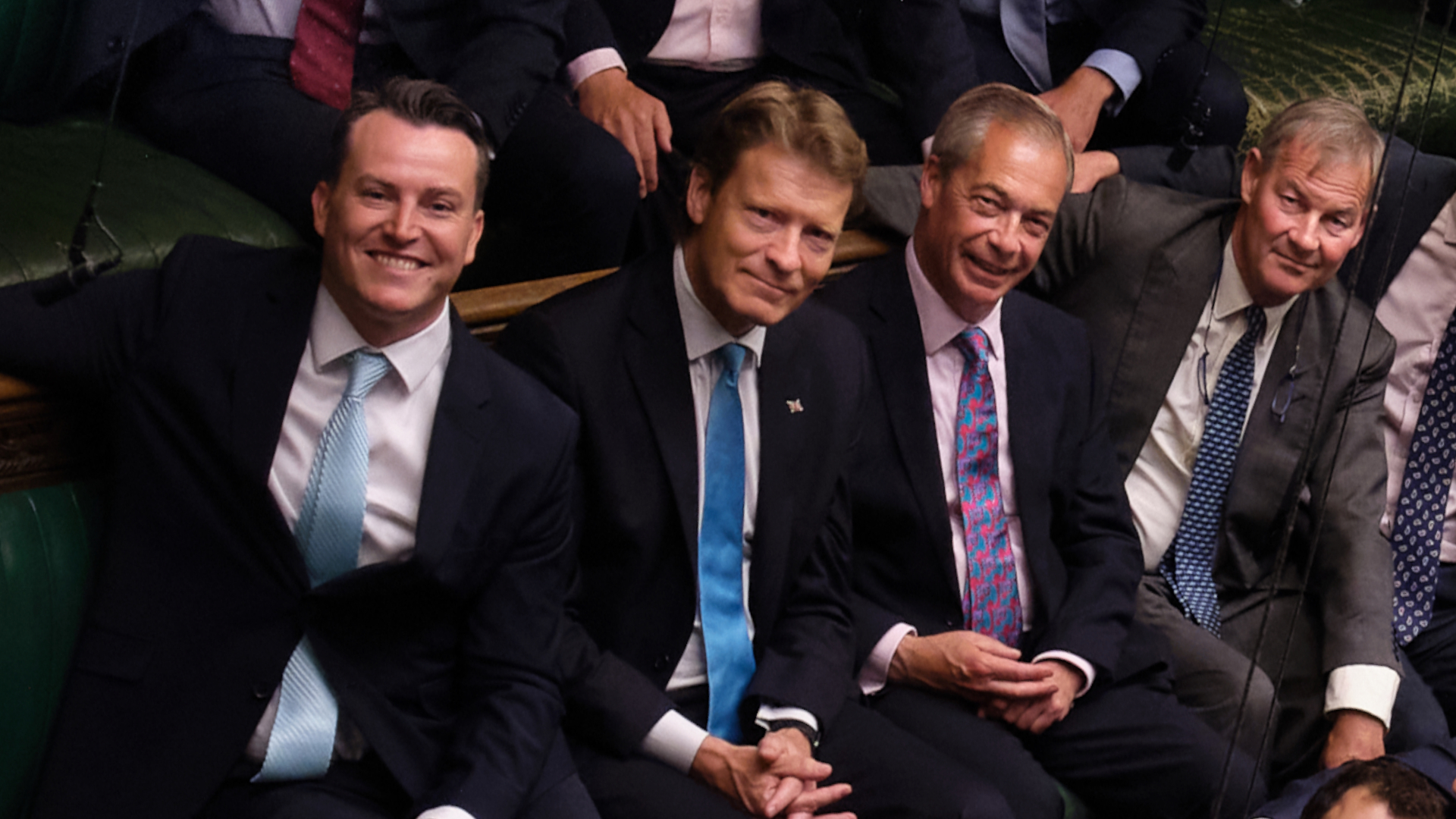
Reform UK can only be described as an outlier in UK politics, its existence shattering the once two and a half party system we had with the Conservatives, Labour and the Liberal Democrats. Whilst yes, the Green Party also has its rise, with Zack Polanski’s charisma drawing in the keen left voters that are at a loss within the disillusionment of Labour’s government, Reform’s sharp rise in the polls begs one simple question.
Why Reform?
In this article, I analyse some of Reform’s tactics or their contextual factors into three sections. These are the factors (I personally feel) that have some part to play in why people vote for them.
Reform’s media presence is something to be admired and questioned. In fact, this presence has been so questioned that the BBC released a statement clarifying why Reform had garnered so much attention from them. Every news article including some sort of politics from the UK seems to focus on Reform UK, or some sort of negative about one of the other parties. Whilst yes, this press can also be negative, there didn’t seem to be anyone else who’s… also getting good press. The only other leader who seems to be getting positive news spun on them is the Greens Leader, Zack Polanski. This media influence does help Reform majorly. In fact, from a Guardian Article in September, a study from Cardiff University showed that Reform had under a ⅕ of mentions in ITV’s News At Ten, compared to the Liberal Democrat’s 6.2% (even though the Liberal Democrats have many more MPs in Parliament then Reform does).
When I looked at the social media post for this specific article, one comment stuck out to me.
‘Reform provides good telly. That’s what we pay our TV licenses for.
This made me realize something. People don’t take Reform UK as a serious ‘opposition,’ from a media standpoint anyways. Look at Nigel Farage being on I’m A Celebrity in 2023. Yes, the Reform Leader came third out of twelve ‘celebrities,’ but why did he take the opportunity to do it? He didn’t go on the show to spread ideology, though one of my main memories of that season was his argument with social media personality Nella Rose, in which a lot of people thought they both looked silly. In fact, a joke within the season was that Farage wanted airtime. He didn’t want to spread his rhetoric, or Reform’s ideas at the time.
The politician just wanted airtime, in order to be a recognized figure. This is what has pushed Reform’s success majorly, in my opinion. Other political party leaders, such as Keir Starmer, or Kemi Badenoch, don’t really have that cult of personality I could argue that Nigel Farage has. Which, I would argue, is a blaring warning to how politics has become an entertainment stage rather than what people take seriously. Farage’s success as a political party leader relies less on his political rhetoric and his own personality.
The more you look into Reform’s actual media coverage, taking away Farage, the more they come across as the people’s ‘protest vote.’ Whilst every party has their negative blows, it seems to me that Reform’s media coverage is more… actual negatives then anything good recently. Especially after their landslide win at the local councils, most of Reform’s articles are about their poor efforts within these councils. Nothing about actively good policies they’re pushing through (which, I have not found anything on either), and nothing about how they will actually be a good governing party. Their populist efforts, through Nigel Farage, are slowly losing their traction. Articles about their polls are more warnings rather than actual victories, which… isn’t actually a good thing. People only see Reform as a protest, and not as an actual, viable threat to the Two Party System we have in place. News outlets see them as a warning to the UK in recent terms, rather than a feasible party.
Tactical voting seems to be the main thing on everyone’s brain when it comes to the government. The 2024 election arguably was not one that Labour won, but rather the Conservatives lost. Now? The polls seem to be showing that the same formula is happening again, but this time with Reform. After the discontent of the Conservative Government for 14 years, it is not a surprise that a voter would turn their back on the party. However, arguably, are we seeing the same pattern with the Labour Government? It’s not hard to suggest we are, and we’re only a third of the way through their term. Policies that were initially popular by the public (social media bans/regulations) went down in public estimation after Sir Keir Starmer announced the policy ideas within Parliament, showing that the Labour Government has, possibly, already lost their power with the people.
Reform UK seems to be riding off the coattails of the discontent of the Conservatives too, with multiple MPs (such as Lee Anderson) defecting to Reform. A good part of the party’s main makeup, in fact, seems to be defecting conservative MPs. This could mean one of a few things: that Reform are slowly becoming the new, main right wing party in UK politics (which I’d argue is not necessarily the case) or, they came in at the right time to cause more ‘damage’ to the main two parties. Kemi Badenoch’s policy has become increasingly more right wing and controversial, which has somewhat been credited towards the public’s sudden swing towards Reform. Not to mention, Starmer’s immigration policy has also taken a right wing stance, reflecting the politics of the socialist government in Denmark.
This apathy towards the main two parties, and County Council voting in 2025 has shown that the people are wanting change, one that they think Reform can give them. I would argue, however, that polls are more of a tactical scare than honest fact. When looking at the polls for the 2024 General Election, Reform UK predicted to do much better than just Four Seats. Whilst yes, their vote share was the 3rd highest in the UK, they did not do as well as the Liberal Democrats, who primarily focused on areas where they knew they could swing their votes. It can be argued that Reform’s seemingly strong loyalty waves across the country are simply not concentrated enough to garner the votes the party needs to gain actual, tangible seats. With their recent dive in the polls, I think we are actually beginning to see the end of this ‘protest vote’ for Reform.
Admittedly, before writing this article, I had no intention of reading the Reform UK manifesto. To me, Reform’s “popularity” has almost nothing to do with policy pledges or written promises, only their certain insistence on immigration. However, I decided to take a look and see if I recognized any of the other policies mentioned in the manifesto as a reason people were ‘drawn into’ the ‘charm’ of Reform.
One thing I did pick up on was Reform’s major immigration rhetoric, which as mentioned above has been a part of their outreach. When reading through their manifesto, one of the first things they said about their immigration policy was to “Leave the European Convention on Human Rights. Zero illegal immigrants to be resettled in the UK New Department of Immigration.” This… is a pretty scary rhetoric to have, if anything. Leaving a Convention that has upheld Human Rights since 1950, weakening individual rights within the UK and leading to a loss of political security for citizens. Whilst yes, it might require some regards of reforming and changing, the fact that Reform wants to leave a convention that has provided a legal framework for the UK is a pretty weird thought.
Another interesting policy-point on Immigration is that International Students require… “essential skills,” in order to remain in the UK. What would Reform count as an essential skill? Particularly when, Universities currently are seeking out International Students to come to the UK. It is important to keep in mind that International Students are a makeup of universities, and some do come to the UK in order to stay and have a career within the country. Enabling a policy that restricts them from doing it, especially when most students do not stay, without ‘essential skills’ that are not even named on the manifesto, seems pretty detracting from a student perspective.
As I read through the manifesto, their main economics seem to be more concerned about cutting and slashing spending and taxation where possible. This also means a major slash and shift on Net-Zero Policy. Whilst this “might be good” for businesses and up-coming entrepreneurs, reading further into the manifesto: Reform seems to want to… scrap any sort of laws, and arguably relationships with the EU. The EU acted as a sort of ‘trading hub’ for the UK, and as Reform seems to be a business-foremost party, rivaling the Conservatives in that regard, it's honestly a bit baffling how little they actually are benefitting businesses. Not to mention, for a party that targets the working class, little is actually done to benefit and support the working class.
As mentioned before, I believe their manifesto has actually little influence on their votes within the UK. Their policies showcase generalized right wing rhetorics, which I don’t believe most people are voting for. Looking at this article from The Guardian, which, whilst it is a month old, showcases perfectly this point. A good amount of people who are looking to Reform UK are not even necessarily looking for their immigration rhetoric, they’re looking for help that the Labour and Conservative governments may not have given them. Thus, I think the idea that Reform voters look to Reform policies is not necessarily the case at all.
Overall, Reform UK’s influence is slowly draining. The polls are showing a sudden drop in intention to vote for them: going from a strong 29% (their highest on the 14th May) to now dropping 4% to 25% (22nd December). This is their lowest poll in a while – and it also shows an increase of voters returning to the main two parties. Nigel Farage’s power as a political leader is dying down, especially with public opinion of him shifting. Farage has been under a lot of pressure from many ends, recently from remarks his party have made and his supposed own past of prejudice being brought to light. The people who vote Reform do not mostly share Farage’s rhetoric I’d argue. In fact, most Reform UK voters seem to be looking for a way out of the two main parties ‘derailing’ the UK over the past 15 years. The consistent controversy and the poor performance within city councils are forcing people to look past Reform, and make them ask the question:
If not Reform, who can I trust to lead?
.svg)
Grace is a Politics & International Relations student at the University of Nottingham. Her main interests lies in the rise of right wing politics, and terrorism studies. However, outside of politics, she enjoys art, podcasting and writing.
.svg)


.jpg)
.svg)
.svg)