
.svg)
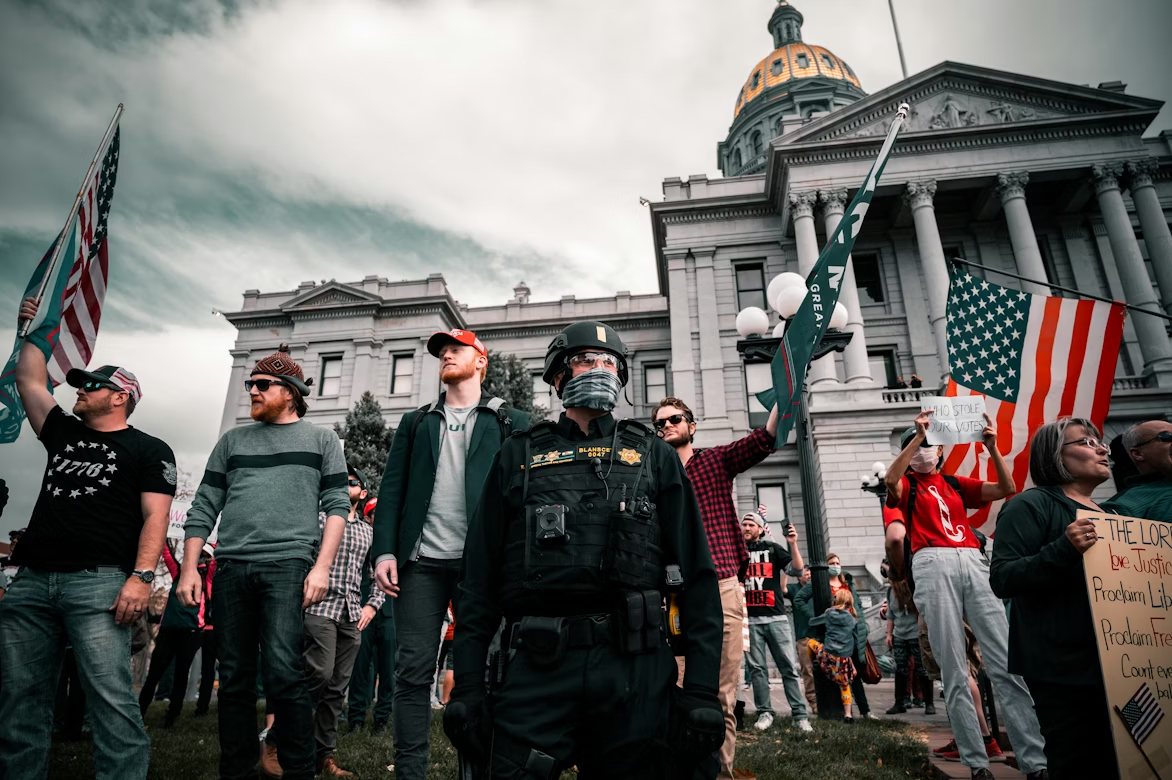
Image - Colin Lloyd
In 2022, A YouGov survey found that 43% of Americans believe it is likely that Civil War will break out within the next 10 years. In the United States, rising political violence and a declining sense of democracy under the Trump administration have intensified concerns about such a possibility. Civilians and politicians are drifting further and further apart in ideology, with researchers at the University of Southern California noting that congress is now more polarized than at any time since the late 1870s Reconstruction Era.
Trump’s own actions have demonstrated his willingness to ignite political violence. In relation to the Jan 6th riots on the Capitol building, Trump instructed his followers: “And we fight. We fight like hell. And if you don't fight like hell, you're not going to have a country anymore.” Here, Trump refused to agree with the democratic voice of the people, by framing his loss of the 2020 election as ‘rigged’ and in need of a violent uprising to be overturned. To many, the very fact that these statements and the riots weren’t a career ending moment for Trump defines just how normalised political violence has become, and arises questions of his further use of power to ignite political violence and erode democracy. As Democratic Committee chair Bennie Thompson reflected: “When I think back to January 6th … I am frightened about the peril our democracy faced”.
This declining sense of democracy in the people is a historic catalyst to many violent internal conflicts - such as the Syrian civil war, for example. The Polity Data Series, a political data organization, scores political regimes on a scale from –10 (fully autocratic) to +10 (fully democratic). In 2020, towards the end of Trump’s term, the organisation scored USA a +5 score. This meant USA had slipped into the definition of an ‘anocracy’ – an internationally recognised danger zone holding elements of authoritarian rule, where the nation is vulnerable to political violence such as civil war. Subsequently, in 2021 under Biden, the score jumped back up to +8. Other democracy indices, such as the Economist Intelligence Unit’s Democracy Index, do not definitively use the term anocracy, however still rate the U.S. as a “flawed democracy,”. The USA, therefore, may be less democratic under Trump than many think.
More recently, Trump’s executive order to establish ‘specialised’ national guard units to combat city crime is sparking question of his true intentions of his use of the National Guard. According to the Trump Administration, the order was signed because of rising crime in cities such as Chicago, with Trump stating: “They need help badly — Chicago desperately needs help. Just look at the crime statistics.” However, upon viewing statistics by Chicago Police Department, total violent crime is down at least 22% thus far in 2025, while there have been 90 fewer homicides and more than 400 fewer shootings compared to last year. Similar trends are visible for other targeted cities, such as Washington D.C and New York. Within these cities, there is 1 common similarity – democratic control. While Trump boasts his motive as protection of American citizens, the contradiction of his words to fact demonstrates his true intentions for use of the national guard; introducing armed control in cities that deem no threat but simply hold a different ideology.
This idea is seen further through Trump’s speech to Military leadership in Virginia, one month after his passing of the executive order, stating: “You know, the Democrats run most of the cities that are in bad shape … they're very unsafe places and we're going to straighten them out one by one” followed by “We should use some of these dangerous cities as training grounds for our military national guard”. With the statistics again showing that these cities are becoming safer, his speech consolidates that the passing of his executive order was likely heavily influenced by differences in political ideology. If Trump is willing to deploy troops simply based on a difference in political thought, who knows if a civil war is possible under his control.
Retired Major General Randy Manor, former acting Vice Chief of the National Guard Bureau, expressed deep concern about the broader implications: “the administration is trying to desensitize the American people to get used to American armed soldiers in combat vehicles patrolling the streets of America” and states he is “concerned the administration is transitioning the military’s role … from protection to intimidation”.
Further, political violence is growing in America, as seen by the United States Capitol Police statement that there were more direct threats against members of Congress in 2024 than ever before. Within the past three years, we have seen three major acts of extremism against Trump Administration: the murder of UnitedHealthcare CEO Brian Thompson, the attempted assassination of Donald Trump, and assassination of MAGA activist Charlie Kirk. Through these events, it’s clear Americans are starting to see the opposite party as a threat in need of elimination, backed by the fact that 55% of Americans feeling angry when thinking about politics, according to data conducted by the Pew Research Centre. Charlie Kirk’s death prompted comments from key political associates and social media platforms, such as Elon Musk stating “The left is the party of murder” and even going so far as Chaya Raichik, owner of popular anti-left X account ‘Libs of TikTok’ to declare “THIS IS WAR.”.
As Barbara Walter (political scientist and civil war expert) puts it in a 2023 TED talk, “The people who tend to start civil wars … are the groups that had once been politically dominant, but are in decline”. With Americans turning against Trump’s authoritarian governance in protection of their own democracy, and increasingly responding with radical political violence, this statement clearly applies to Trump’s MAGA regime. If civil conflict begins with waning democracy, political extremism and an increasingly elitist ruler, then America may indeed be closer to breaking point than many would like to admit.
Lara is a Politics student at the University of Leeds. She is specifically interested in USA and Global politics. Elsewhere, she enjoys baking and watching football.
.svg)


.jpg)
.svg)
.svg)